

The paid-search read that names every wasted dollar.
Beacon finds the people who don't know a business yet. Meridian makes the money spent to reach them actually work.
It's a read of the Google Ads account itself — not the agency's summary of it — that names the waste, the growth, and the exact moves, in plain language with a dollar tag on each.
The account is where the money is spent and where the truth lives: every campaign, keyword, search term, and conversion action, read directly instead of through a monthly slide.
Meridian runs on Beacon's engine — the same report renderer and scheduler — pointed at the paid side of the same problem.
Two reads, one account.
The waste audit
Part one reads the account for money being lost right now — junk placements, dead campaigns still burning budget, winners capped while losers run free, search terms bleeding on navigational traffic.
Each leak is named, dollar-tagged, and paired with its fix — including the quiet poison: conversion tracking that counts page-views as conversions and misleads the bidding.
The opportunity read
Part two reads the same account for growth levers already paid for but sitting unused — usually a rank-choked winner: a campaign converting efficiently while losing most of its impressions to ad rank, not budget.
Alongside it: conversions tracked with no dollar value, audiences collected but attached to nothing, and campaign types held back until the tracking is clean.
What it is
A read of the account, not a dashboard.
A dashboard shows numbers. It doesn't tell a business which of those numbers is a lie, or which line item is quietly burning the budget while a winning campaign starves.
Meridian reads the whole account and returns a two-part report: what's leaking, and what's sitting unused. Every finding carries a one-line verdict, the reading behind it, and a dollar-or-effort tag — the same evidence-led format as a Daylit search report, pointed at paid.
Nothing about the account changes in a read. The audit is safe to run on any account, because its only job is to see clearly.

2
reads in every report — a waste audit and an opportunity read, each a named list with a dollar tag on every line
14
leak and opportunity classes the account is read against, from junk placements to rank-choked winners
0
changes made to a live account without a state backup and a human approving that exact edit
The honesty line
The read is proven. The fixes are human-gated, always.
The account read is real, built and shipped against a live Google Ads account and checked line by line against the API. Every dollar and percentage in the report traces to the account's own data.
Acting on it is a separate, deliberate step. The fixes an audit identifies — placement exclusions, negative keywords, device bids, conversion-action cleanup, bidding changes — are live-account edits, and they are never made unsupervised.
Every mutation is preceded by a backup of the account's state, stated to the client, and gated behind approval on each individual change, with per-change rollback. Meridian is never sold as hands-off, because a live ad account with real spend is not a place for it.


What lands on your desk
Two lists, every line with a dollar tag.
The read comes back as one report in two parts: the waste audit — money leaking right now, sorted by leak class — and the opportunity read, the growth levers already paid for but sitting unused.
Every line carries the dollar it protects or unlocks, and the specific move that does it.
Three ways to run it.
The read-only diagnostic: a live account read across waste and opportunity, delivered as the two-part report.
It's safe on any account because it changes nothing. It's the honest first look — and the thing that shows whether the rest is worth doing.

A project that acts on the audit: the placement exclusions, negatives, device bids, conversion cleanup, and bidding moves the read identified.
Every change is backed up first, approved one at a time, and reversible per change. A live ad account is edited with the care that real spend deserves.

A retainer: the account is re-read on a schedule, drift is flagged, and a fresh report lands.
It's periodic, not a real-time dashboard — the point is a steady, honest pulse on where the money is going, not another screen to watch.
An agency reports its performance. Meridian reads the account.
Most companies running Google Ads through an agency see one thing: a monthly summary written by the people being paid to run it. It reports what went well. It rarely names what leaked.
So the questions that matter go unanswered. How much of this month's budget landed on junk inventory instead of real prospects? Are the reported conversions real leads, or page-views inflating the numbers the bidding optimizes against?
Meridian's PPC audit answers those from the account itself, not from a self-reported summary. It authenticates to the account, reads across campaigns, keywords, search terms, conversion actions, audiences, and geography, and hands back a report that names every recoverable dollar and the specific move that recovers it.
The unit of work is the ad account, not the website. It runs on Beacon's engine — the same report renderer and scheduler, pointed at the paid side.
The questions that come up first.
No. The audit is read-only — it authenticates, reads the account's own data, and returns a report.
It makes zero changes. That's why it's safe to run on any account, including one an agency currently manages.
An agency reports its own performance — written by the people being paid to run the account. Meridian reads the account itself, from the raw campaign, keyword, and conversion data, and names what the summary leaves out: the wasted spend, the inflated conversions, the growth sitting unused.
It's a second opinion drawn from the account, not from a slide.
Remediation makes the specific fixes the audit found — placement exclusions, negative keywords, device bids, conversion-action cleanup, bidding changes.
Before any edit, the account's state is backed up and stated to the client. Each change is approved individually and can be rolled back on its own. Nothing is ever changed unsupervised.
No. Meridian reads the account wherever it lives — an agency-run account, an in-house one, or a new one being planned.
The Audit is often run precisely to see whether the current setup is working before deciding anything.
That's one of the most common and most valuable finds. When page-views or dead goals are counted as conversions, the account's automated bidding is optimizing against a lie — quietly wasting spend on the wrong signal.
Meridian names exactly which conversion actions are inflating the numbers, so the fix comes before any bidding change is trusted.
Priced on the spend it protects.
Meridian is delivered as a service — senior paid-search work and proprietary tooling together, run on Daylit's own infrastructure rather than an agency's overhead.
The Audit starts at around $1,200/month, or as a one-time read for an account being evaluated. Remediation is scoped and quoted as a project against what the audit finds. Watch is a monthly retainer that keeps the account read on a schedule.
Every tier holds the same line: the read is proven, and no live change is ever made without a backup and a person's approval.
The first step is the two-read audit: one month, every wasted dollar named.
The take-away
Find the waste yourself, today.
A few minutes in your own account with this checklist names most of the waste before anyone is hired. When you want the full read with dollar figures attached, Meridian picks up where it stops.
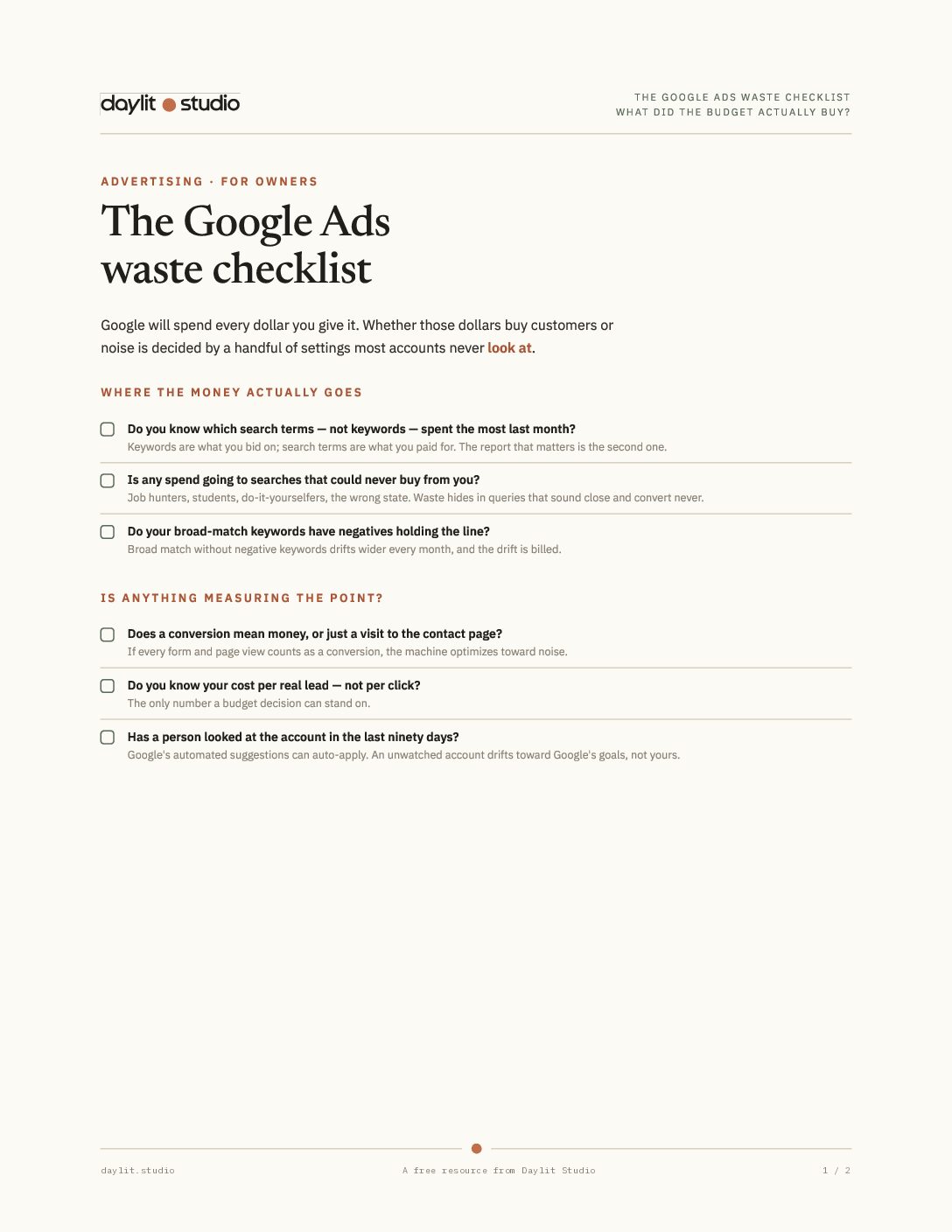
Every engagement starts with one of these