A list of problems is not the same as a solution.
For years the SEO tools on the market did one thing well and one thing only: they crawled a site, produced a list of two hundred problems, and considered the job done. The finding was the deliverable.
Everything after it — deciding which problems actually move rankings, making the change, and confirming it worked — was left on the client's desk. That is the expensive part, the part that needs judgment, and it was always the part the tool walked away from.
Beacon was built to close that gap: an SEO service that doesn't stop at the finding. It reads the analytics and Search Console data behind a site, finds the specific pages where a small change moves the needle, drafts that change against real ranking evidence, ships it once a person approves, and then measures whether rankings actually responded.
The loop runs continuously. The result isn't a report that ages the moment it's printed — it's a site that keeps improving while the business runs.
The same engine, two levels of reach.
OBSERVE runs on the site a client already has — typically plain WordPress with Yoast, left exactly as it is. Beacon reads everything and advises, page by page, with the evidence attached to every finding rather than a bare red X.
It surfaces striking-distance pages — the queries sitting at positions eight through twenty, one push from page one. It catches content decay the moment a page starts shedding clicks, and flags it for a refresh before the ranking is lost.
And it tracks the signal almost no one is watching yet: whether ChatGPT, Perplexity, Gemini, and Google's AI Overviews are citing the site at all. OBSERVE is the strong, safe advisor — Daylit and the client's team apply the fixes by hand.
OBSERVE starts at around $2,000/month.

CONTROL runs on a site Daylit builds, and it changes what the engine can do. Beacon owns the rendering layer, so a finding stops being a recommendation to apply by hand and becomes a single render-tested patch that propagates across every page at once.
Each patch is validated against the live page before it ships, so nothing breaks on the way out.
The site largely maintains itself: a scheduled audit catches a systemic regression, locates the exact function causing it, drafts the patch, render-tests it, and holds it ready for approval. CONTROL is the moat.
CONTROL is scoped and quoted per project.
What it is
An operating system, not a report.
A conventional SEO tool is a smoke detector: it sounds an alarm, hands over a list, and the work of putting out the fire stays with whoever is standing there.
Where a one-time SEO audit ends at the list, Beacon runs the whole cycle. It reads the live analytics and Search Console signal, finds the pages one small change from a better position, drafts that change against real ranking data, and — once a person signs off — measures the result and feeds it into the next pass.
Nothing publishes on its own. What builds up over time isn't a backlog of findings, but a site that compounds its own gains.

One patch. Every page. Proof no SaaS can match.
A per-site SaaS tool cannot do what CONTROL does, and the reason is structural: no SaaS owns its clients' rendering layer. Beacon does, on every Daylit build.
A fix proven on one page becomes a single render-tested patch that ships across every page at once. And because every CONTROL site runs on the same master theme, a win proven on one site rolls out to all of them — each time with the evidence attached.
That leverage is not a feature bolted onto a tool. It comes from building the site and the engine as one system — the seam a SaaS vendor can never cross.
4
AI answer engines tracked for citations — ChatGPT, Perplexity, Gemini, Google AI Overviews — scored beside ordinary rankings
8–20
the striking-distance band Beacon hunts — the queries one push from page one
0
pages published without a person's approval, on either tier — every fix is human-signed
Built in, not bolted on
A Daylit-built site does the SEO basics from day one.
On most sites, SEO gets added later — by hand, one page at a time, by whoever remembers. Which is why most sites are missing half of it.
A clean title. A real description under the link. The structured data that decides a plain blue link from a rich result. Alt text. A current sitemap. None of it is hard; it just has to get done on every page, forever — and that is the part that slips.
On a Daylit build it doesn't slip, because the theme handles it. Every page ships with its own clean title, description, structured data, and markup the day it goes live. The hygiene search engines and AI answers reward is the default, not a task — and Beacon keeps it that way.

The questions that come up before a switch.
GEO is search optimized for the AI answer engines, not just Google's blue links. When someone asks ChatGPT or Perplexity a question, those engines cite sources. Beacon tracks whether a site is among them, works out its share of voice across the AI engines, and reports it beside ordinary rankings. Most tools still count only blue-link positions — half the picture in 2026.
No. Self-healing describes the detective work, not the deciding. On a CONTROL site, a scheduled audit catches a regression, traces it to the exact function causing it, drafts the fix, and render-tests it against the live page. Then it holds the patch, ready for a person to approve. A human always pulls the trigger on anything that publishes.
A site that stays as it is calls for OBSERVE: Beacon reads everything and advises, and the fixes are applied by hand. A site Daylit builds or rebuilds gets CONTROL, where fixes propagate automatically across every page and the site largely maintains itself. OBSERVE is the strong, safe advisor; CONTROL is the moat.
Never. Beacon drafts content against real ranking and Search Console data, with the facts whitelisted so nothing is invented — but every draft and every fix waits for human approval. That holds on both tiers, without exception.
CONTROL runs on the master theme because that is what makes the propagation and self-healing possible. The site, the content, and the data still belong to the client, in full. A client who leaves, leaves with all of it. The reason to stay is that the site keeps getting better — not that anything is held hostage.
This is the part most tools quietly get wrong. The rules of search move every few months: the bar on speed creeps up, a result type gets switched off, the AI engines begin citing sources for new reasons — and a tool built to last year's rules keeps grading a site against a world that no longer exists. Beacon runs off a living standard for how a page should be built to get found, and that whole standard is re-checked against the real state of search every quarter, with the fastest-moving part — the AI-answer side — checked monthly. When the rules move, the standard moves, and what Beacon flags moves with them. That is the difference between current and merely confident.
Senior search work, run leaner, priced fairer.
Beacon is delivered as a service, not a login handed over — senior work and proprietary tooling together, run on Daylit’s own infrastructure rather than an agency’s overhead.
OBSERVE starts at around $2,000/month for the site a client already has. CONTROL, running on a Daylit build with fleet-wide propagation and self-healing, is scoped and quoted per project.
Both tiers include the full loop — read, find, draft, measure — and on both, nothing goes live without a person’s approval.
The take-away
The read, in your hands.
Beacon ships a plain-language worksheet a team can run against its own site — the same ground truth the audit starts from, minus the guesswork.
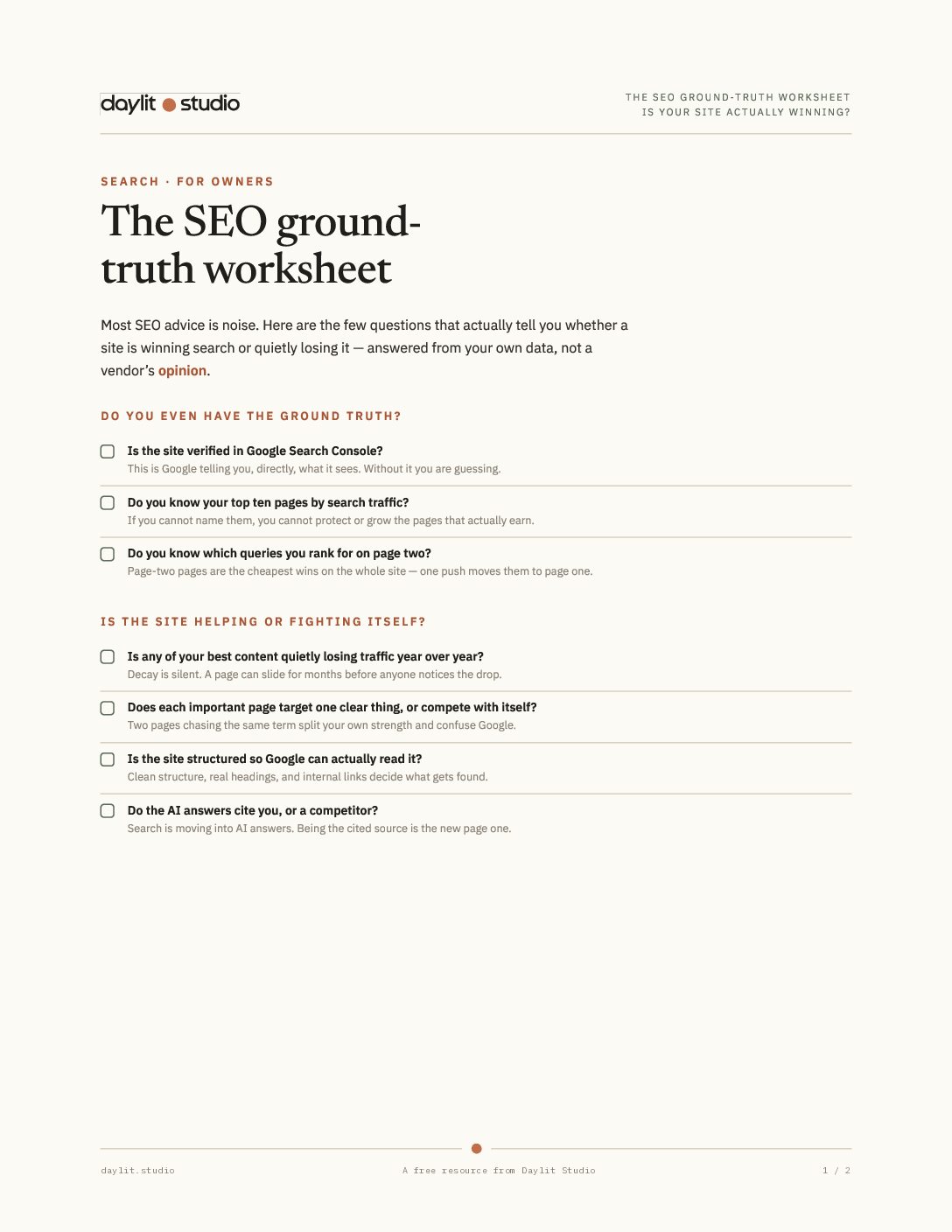
Every engagement starts with one of these